PMMilestone.com
The Global Encyclopedia of Project Management & Controls
An A–Z reference and career-guide library for project managers, planning engineers, project controls professionals, PMOs, construction managers and infrastructure leaders — the official knowledge hub of PMMilestone.org, built by Dr. Hassan Eliwa, PhD.
Our mission
To build the world's most trusted and comprehensive encyclopedia for Project Management and Project Controls professionals.
PMMilestone.com is the official knowledge hub of PMMilestone.org. It is built for the engineers who actually deliver capital projects — and the leaders who govern them. Project management and project controls are taught in fragments — a textbook here, a vendor course there, a borrowed template from a colleague. We consolidate that scattered knowledge into one open, free-to-read encyclopedia covering every concept, methodology, framework, formula and best practice that drives successful projects worldwide.
Topics include Critical Path Method (CPM), Earned Value Management (EVM), SPI and CPI, Estimate at Completion (EAC), DCMA 14-point assessment, project planning and scheduling, cost control, risk management, PMOs, governance, recovery planning, delay analysis, construction management, digital project delivery and emerging technologies. Every encyclopedia entry pairs with the matching calculator or template on PMMilestone.org — the free EVM Calculator, the SPI Calculator, the CPI Calculator, the Schedule Health Checker, the Risk Register Template, the PM Glossary, the Project Controls Academy, and the Books library.
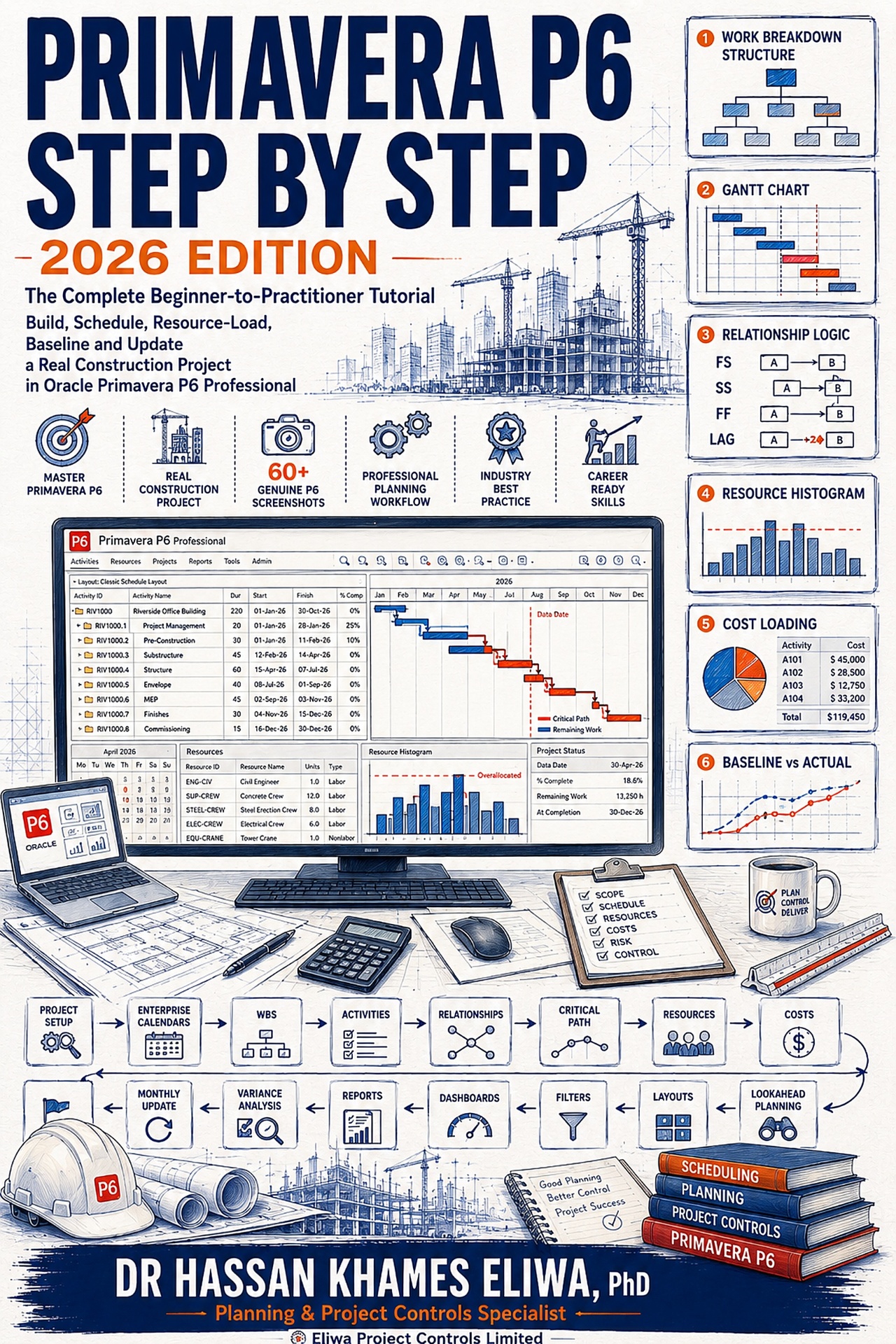
Primavera P6 Step by Step
The Complete Beginner-to-Practitioner Tutorial · 2026 Edition
By Dr. Hassan Khames Eliwa, PhD · Auckland, New Zealand
Master Oracle Primavera P6 by actually using it. This hands-on 2026 tutorial walks you through building a complete construction project — schedule, logic, resources, costs, baseline, and a real monthly progress update — with 60+ genuine P6 screenshots. No theory dumps, no button tours. One real project, start to finish, and the professional habits that make schedules trusted.
Planning Engineers · Project Controls Engineers · Project Managers · Construction Managers · PMO Professionals · Engineering Students
Paperback, hardcover and PDF editions. Links open in a new tab. · See the full book page →
ISBNs
- 978-1-997355-08-3 — eBook
- 978-1-997355-09-0 — Paperback
- 978-1-997355-10-6 — Hardcover
- 978-1-997355-11-3 — Paperback
- 978-1-997355-12-0 — Hardcover
The Critical Path
A Business Novel About Schedules, Claims and Telling the Truth
By Dr. Hassan Khames Eliwa, PhD · Auckland, New Zealand
Six months late. Fourteen days reported. Eighty-four days to tell the truth.
Nadia Farouk is a senior planner who can make any schedule behave. When her company sends her to Dubai to “tidy the programme” on a troubled 600-bed hospital, she expects a few weeks of formatting. Instead she finds forty-seven date constraints hiding a six-month delay, a project director determined to keep his number, a client moving toward termination, and a contract clock counting down to the day her company’s right to claim expires.
To save the project, Nadia must answer three questions that an old forensic delay expert writes on a napkin: Whose delay is it? When did you know? Can you prove it?
A business novel and a complete project controls course in one book. Written by a practitioner with more than twenty years in planning, scheduling, delay analysis and construction claims, it teaches the way the job is really learned: under pressure, on a real project, with real people. Along the way you will learn:
- The critical path method (CPM), total float, free float and the longest path
- Why mandatory constraints hide delay instead of removing it
- How to read a schedule health check, including the DCMA 14-point assessment
- Baselines, progress measurement, earned value management (EVM) and earned schedule
- Windows analysis, time impact analysis (TIA) and concurrent delay
- Notices, time bars and extension of time (EOT) claims under an international standard contract (FIDIC 2017) — see the EOT claim preparation guide
- Resource levelling, recovery planning, and testing and commissioning
- How to write a one-page report that a board will actually read
Every chapter ends with a page from the mentor’s notebook — a short summary of what the chapter teaches. The book closes with a 47-term glossary, a lessons-by-chapter index and three ready-to-use tools: a one-page summary template, an Engineer’s programme-review checklist, and a list of lessons learned.
Planners and schedulers · Project managers · Construction managers · Engineers · Quantity surveyors · Contract and commercial managers · Students of construction and project management — and anyone who has ever been asked to hold the dates.
Paperback, hardcover and PDF editions. Links open in a new tab. · See the full book details →
ISBNs
- 978-1-997355-23-6 — eBook
- 978-1-997355-24-3 — Paperback
- 978-1-997355-25-0 — Hardcover
- 978-1-997355-26-7 — Paperback
- 978-1-997355-27-4 — Hardcover
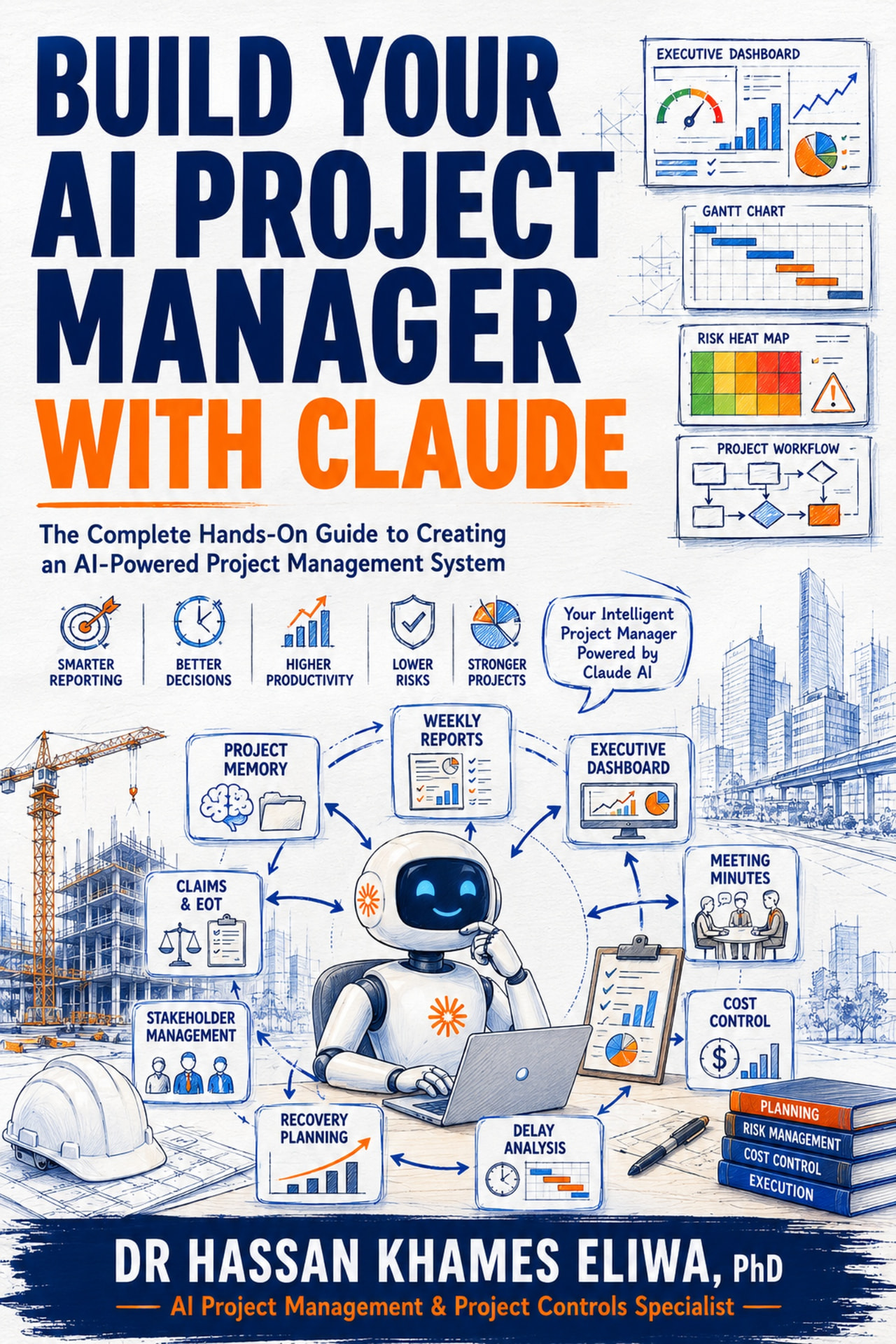
Build Your AI Project Manager with Claude
The Complete Hands-On Guide to Creating an AI-Powered Project Management System for Reports, Meetings, Risk, Cost and Delays
By Dr. Hassan Khames Eliwa, PhD · Auckland, New Zealand
The complete hands-on guide to creating an AI-powered project management system for reports, meetings, risk, cost, delays, recovery planning, and executive decision support.
Stop spending hours writing reports, analysing risks, preparing dashboards, and documenting meetings. Imagine having an experienced Project Manager, Planning Engineer, Project Controls Manager, Commercial Manager, and Executive Assistant working for you 24 hours a day. See the companion AI Project Manager guide for a practical introduction.
- Construction and project managers running live projects
- Engineers and site managers stepping into delivery roles
- Planners, schedulers, and cost controllers widening their scope
- Students and graduates entering the industry
Paperback, hardcover and PDF editions. Links open in a new tab.
ISBNs
- 978-1-997355-03-8 — eBook
- 978-1-997355-04-5 — Paperback
- 978-1-997355-05-2 — Hardcover
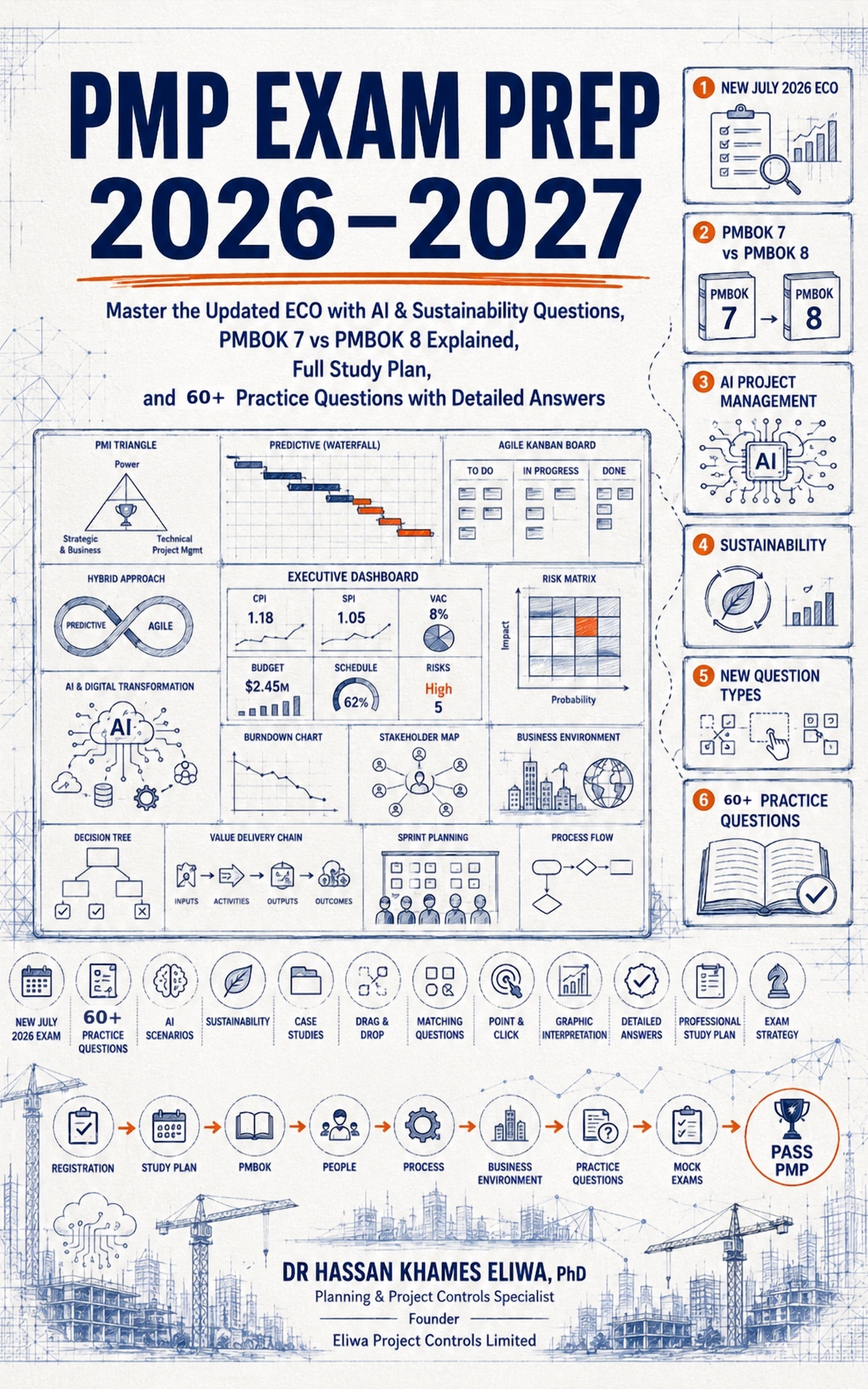
PMP Exam Prep 2026–2027
The Complete Study Guide for the New July 2026 Exam
By Dr. Hassan Khames Eliwa, PhD · Auckland, New Zealand
The first complete study guide built for the new PMP exam launched July 9, 2026. Covers the updated Examination Content Outline, PMBOK 8 alignment, brand-new content on AI in project management and sustainability across predictive, agile and hybrid delivery, the new question formats, and 60+ practice questions with fully explained answers — plus a week-by-week study plan aligned with our PMP first-attempt career guide that takes you from registration to PASS.
PMP Exam Candidates · Planning Engineers · Project Controls Engineers · Project Managers · Construction Managers · PMO Professionals · Engineering Students
Paperback, hardcover and PDF editions. Links open in a new tab.
ISBNs
- 978-1-997355-13-7 — eBook
- 978-1-997355-14-4 — Paperback
- 978-1-997355-15-1 — Hardcover
- 978-1-997355-16-8 — Paperback
- 978-1-997355-17-5 — Hardcover
The Construction Project Manager's Handbook
A Complete Guide to Planning, Scheduling, Cost Control, Contracts, Risk, and Delivering Projects On Time and On Budget
By Dr. Hassan Khames Eliwa, PhD · Auckland, New Zealand
Construction projects rarely fail for one dramatic reason. They fail through a schedule nobody believed, a variation nobody priced, a risk nobody logged, and a conversation nobody documented. This handbook exists to close those gaps.
Drawing on more than two decades in project controls across infrastructure and building programmes, The Construction Project Manager's Handbook brings the full delivery cycle into a single, practical volume — written for the manager who needs an answer today, not a theory to study for later.
- Construction and project managers running live projects
- Engineers and site managers stepping into delivery roles
- Planners, schedulers, and cost controllers widening their scope
- Candidates preparing for PMP, PMI-SP, AACE PSP, and CCP certification — with a chapter mapping this book to each credential
- Students and graduates entering the industry
Paperback, hardcover and PDF editions. Links open in a new tab.
ISBNs
- 978-1-997355-18-2 — eBook
- 978-1-997355-19-9 — Paperback
- 978-1-997355-20-5 — Hardcover
- 978-1-997355-21-2 — Paperback
- 978-1-997355-22-9 — Hardcover
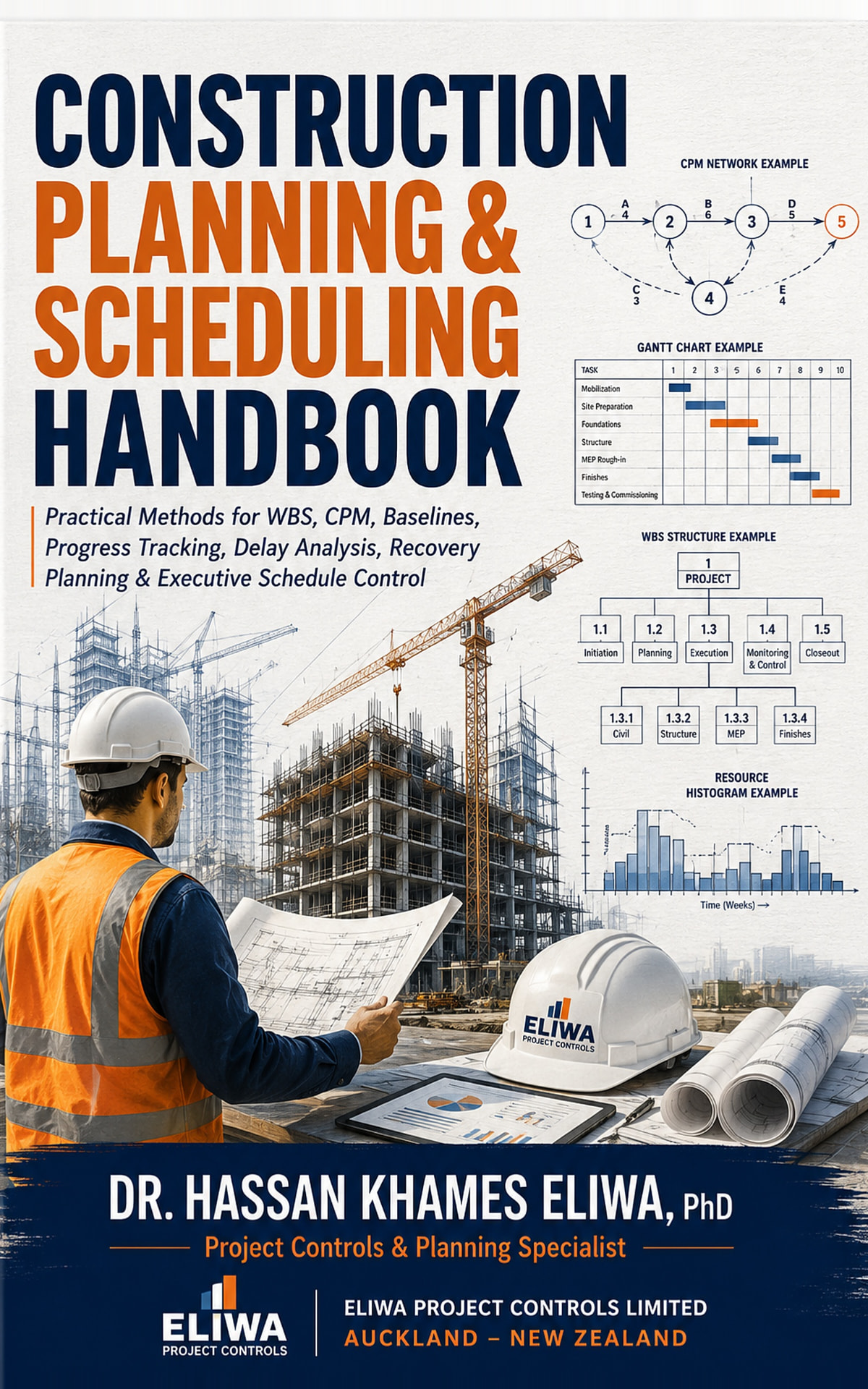
Construction Planning & Scheduling Handbook
Practical Methods for WBS, CPM, Baselines, Progress Tracking, Delay Analysis & Recovery Planning
By Dr. Hassan Khames Eliwa, PhD · Auckland, New Zealand
Construction projects succeed or fail based on the quality of their planning. Master the fundamentals of construction planning and CPM scheduling through practical examples, visual guides and real-world project controls techniques. Learn WBS development, CPM scheduling, float management, progress tracking, delay analysis, recovery planning and executive reporting in a clear and highly visual format.
The Construction Planning & Scheduling Handbook is a practical field guide designed for project managers, planning engineers, project controls professionals, construction managers and engineering students who want to build reliable baselines and make better project decisions.
- Construction and project managers running live projects
- Engineers and site managers stepping into delivery roles
- Planners, schedulers, and cost controllers widening their scope
- Students and graduates entering the industry
Paperback, hardcover and PDF editions. Links open in a new tab.
ISBNs
- 978-1-997355-00-7 — eBook
- 978-1-997355-01-4 — Paperback
- 978-1-997355-02-1 — Hardcover
What you'll find on PMMilestone.com
A–Z Encyclopedia
Research-grade entries on every project controls term — definitions, formulas, applications and curated further reading.
Career Guides
Seven long-form roadmaps from graduate engineer to project controls director, PMO manager and cost control manager.
Companion Calculators
Free EVM, SPI, CPI, schedule-health and risk tools hosted on the flagship PMMilestone.org platform.
Books Library
Practitioner-focused books on Project Controls, Primavera P6 and Earned Value Management by Dr. Hassan Eliwa, PhD.
Career Guides
Seven stage-by-stage roadmaps — from site engineer and graduate, through senior planner and project controls engineer, into PMO and director roles.
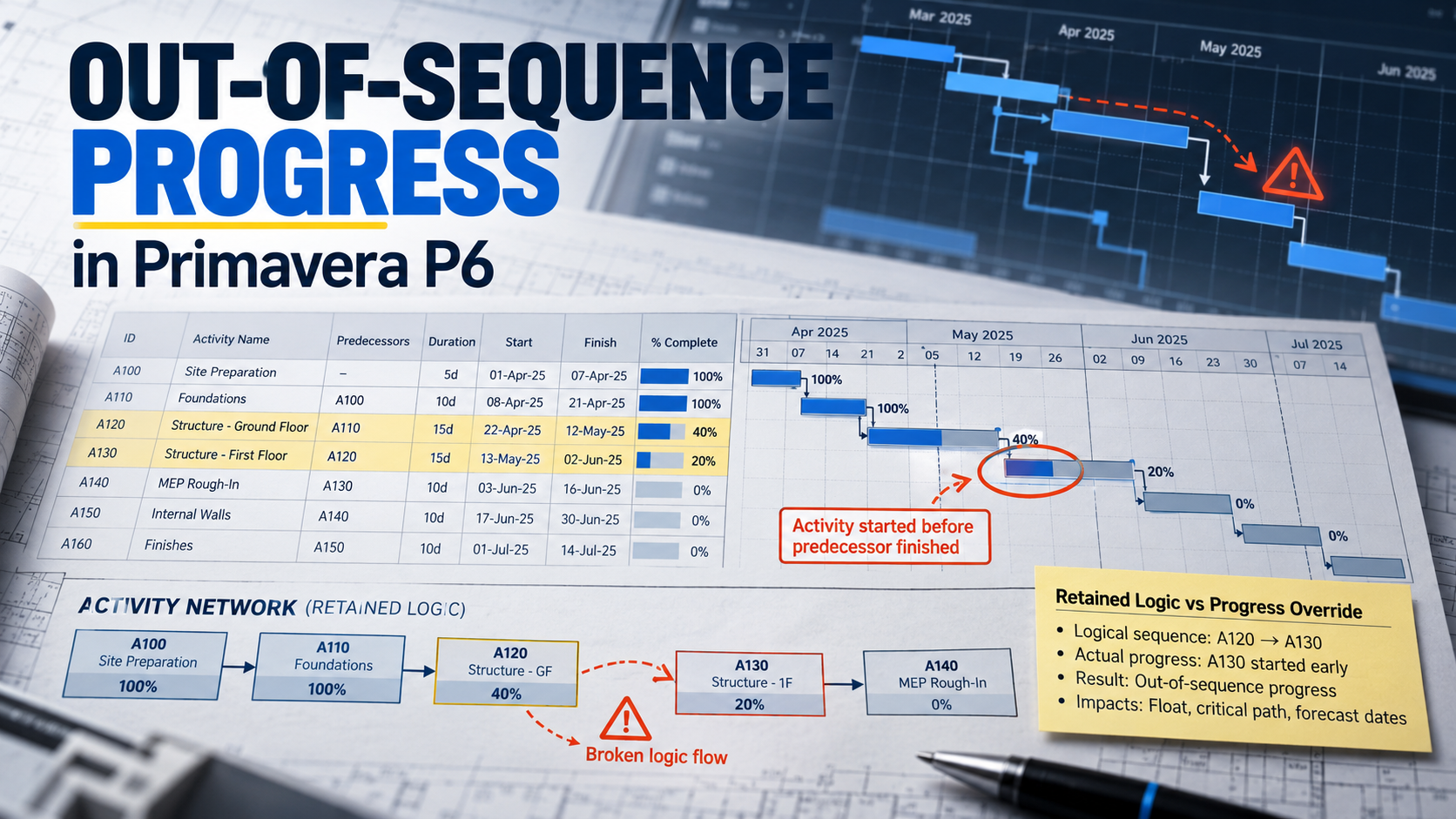
Out-of-Sequence Progress in Primavera P6: Retained Logic vs Progress Override, Explained Through Real Projects
Every scheduler has stood in a progress meeting unable to explain why the completion date jumped. Nine times out of ten the cause is out-of-sequence progress meeting the wrong scheduling option. This field guide compares Retained Logic, Progress Override and Actual Dates through a hospital fit-out example, shows the two-week swing a single setting produces, and gives the monthly routine and decision process used on hospitals, water treatment plants and transport projects.
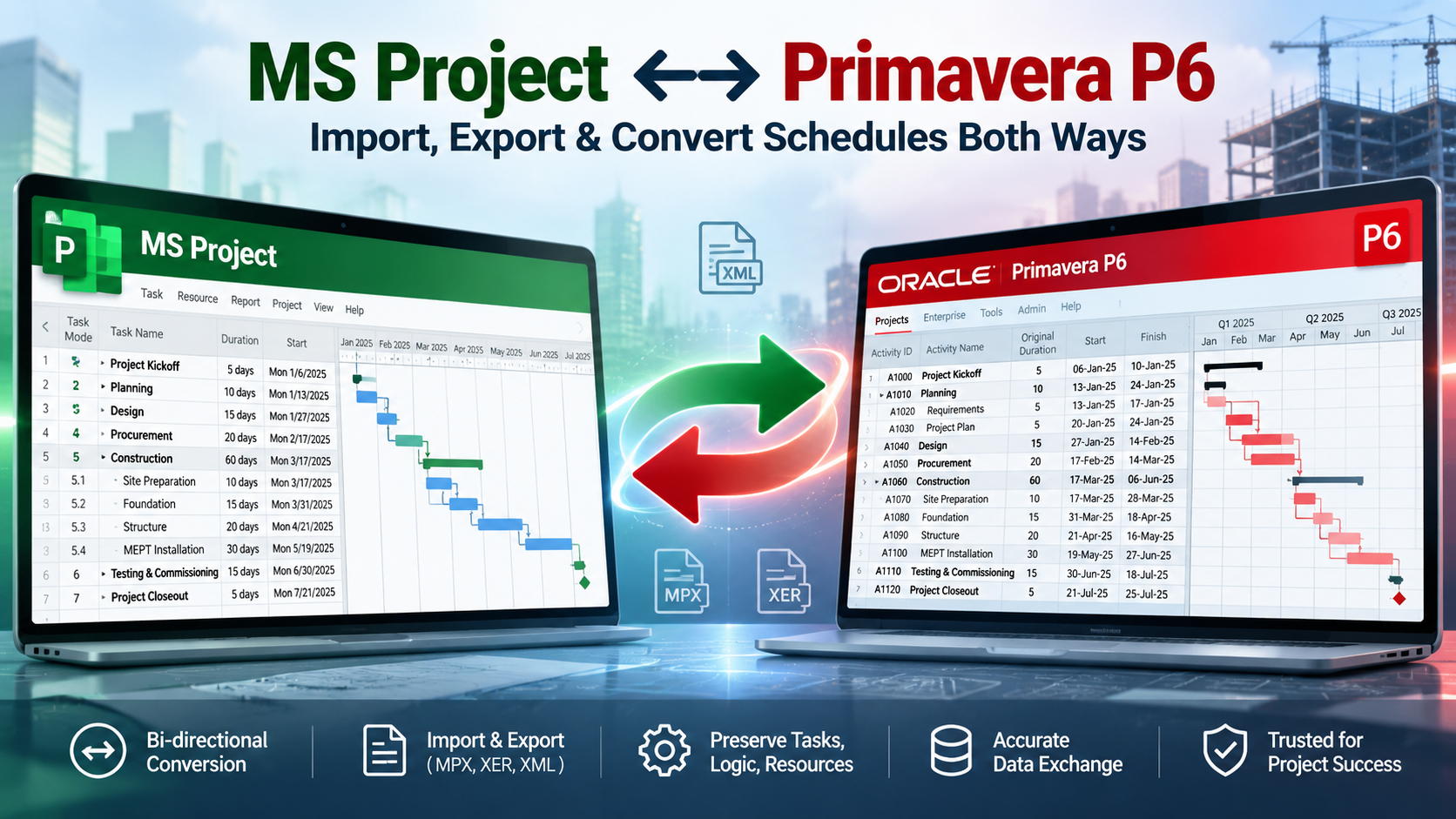
How to Import an MS Project Schedule into Primavera P6 Without Losing Logic
The import itself takes seconds; proving that the converted programme still means the same thing takes disciplined preparation and reconciliation. This field guide explains the data-model differences, the six-stage workflow, the schedule fingerprint, P6 options, a 380-activity reconciliation and a live hospital refurbishment case study.
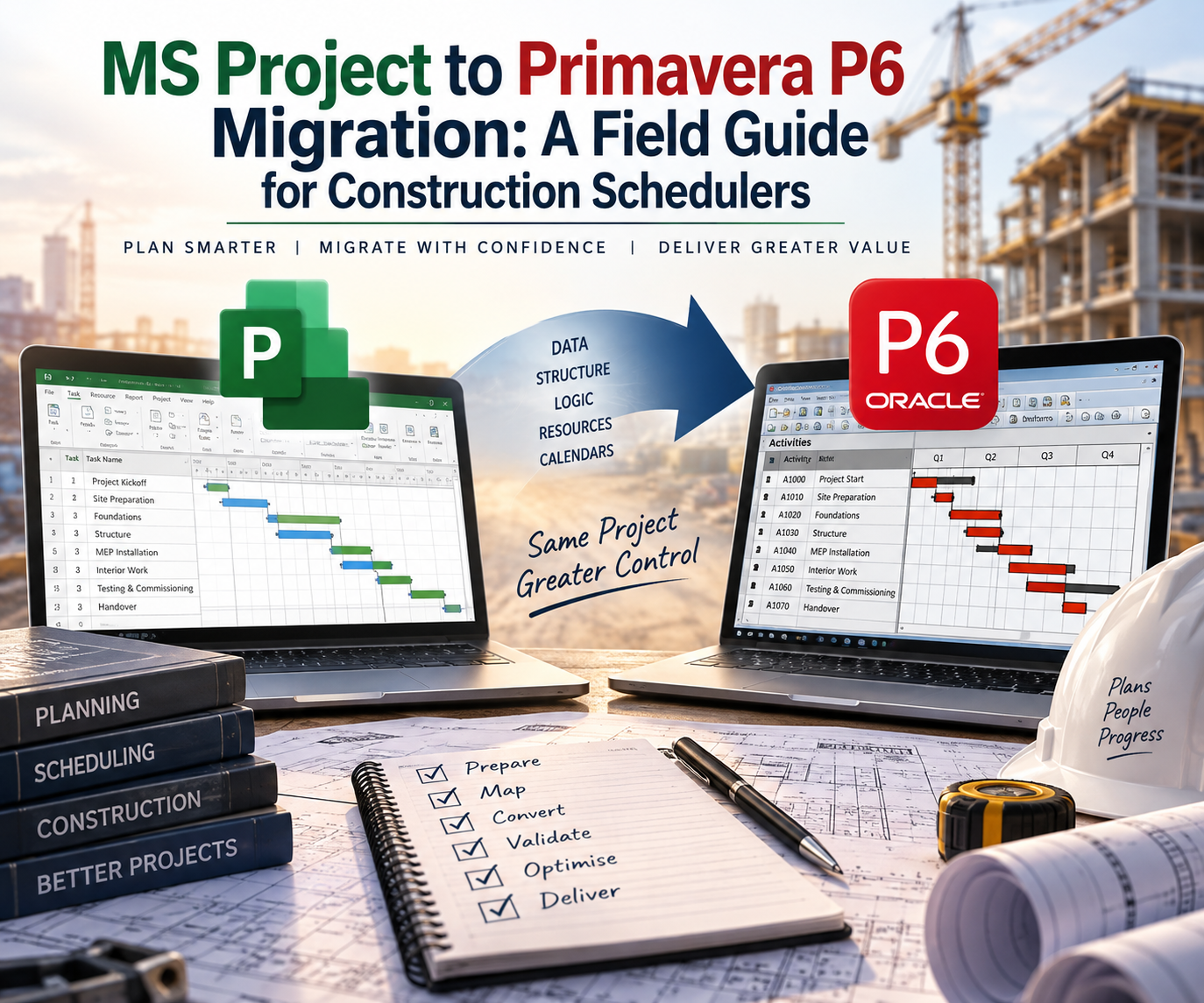
MS Project to Primavera P6 Migration: A Field Guide for Construction Schedulers (2026–2027)
The import takes minutes; the reconciliation is the real job. This guide covers the six-stage workflow, the schedule fingerprint you must capture before exporting, the twelve scheduling behaviours that genuinely move dates between the two tools, three field notes from real conversions, a pre-submission checklist, and the FAQs schedulers actually ask in 2026 as Project Online retires.

AACE Certifications: The Complete 2026 Guide to All Nine Credentials
Every number in this guide — fee, question count, eligibility rule — was taken directly from AACE International's own certification pages on 4 September 2026, because the primary pages for the CCP and PSP carry a noindex directive and the second-hand versions circulating online are frequently several revisions out of date. It covers the three tiers, the real CCP and PSP domain splits, the 70% averaging mechanic, employment verification, the written memo, common mistakes, expert tips, and how the AACE family compares with PMI.
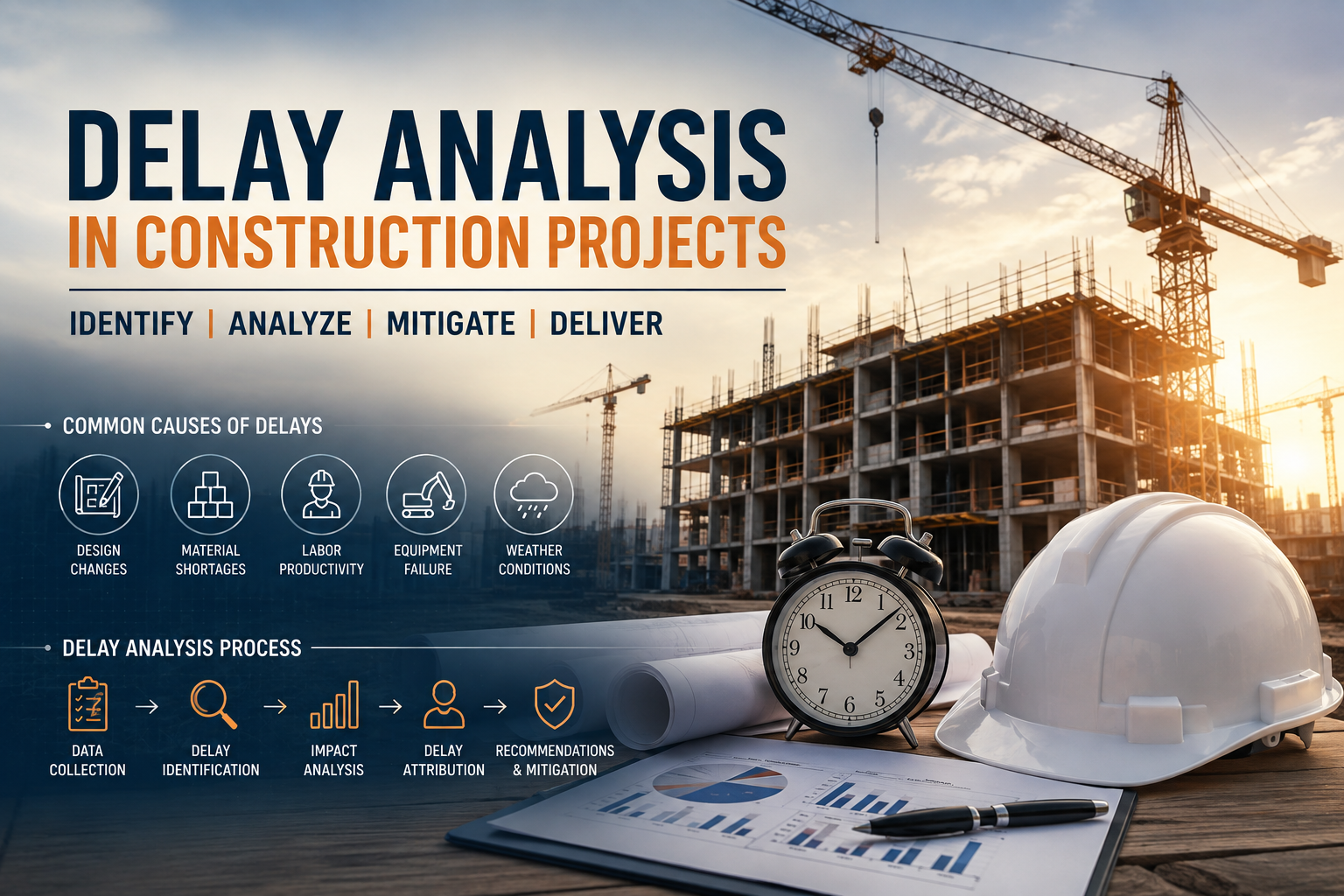
Delay Analysis in Construction Projects: A Planner's Field Guide from Site Records to Entitlement
Every delay determination reduces to three tests — entitlement in principle, causation, and quantum of time. This field guide covers the record-keeping routine, fragnet modelling on a live hospital programme, the two method families, how evidence is actually weighted, classifying critical delay into time and money, float erosion as an early warning, and the notice regimes that defeat more meritorious claims than bad analysis ever does.
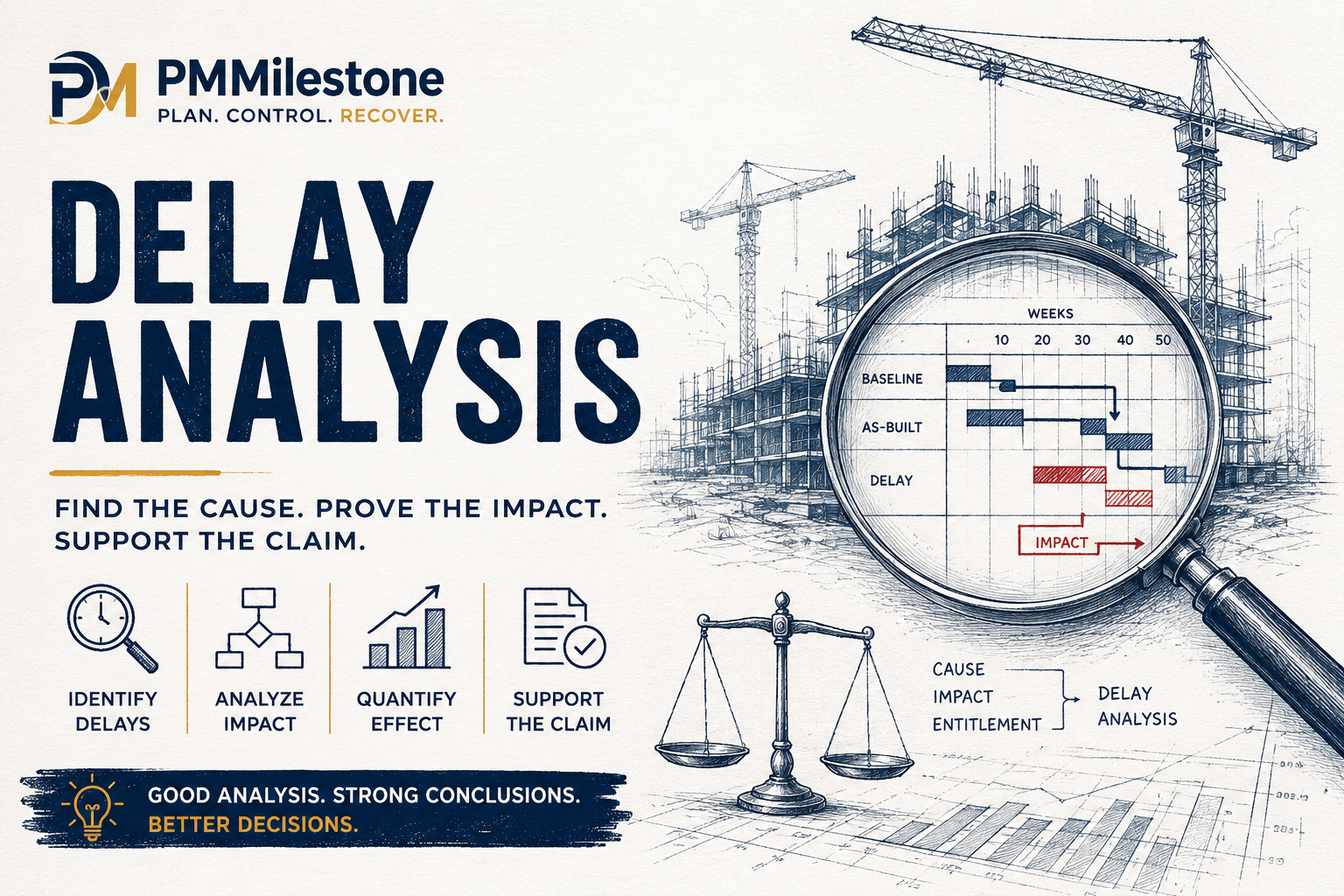
EOT Claim Preparation Steps: Building an Extension of Time That Actually Gets Awarded
Why extension of time claims fail on notice, records and baseline validity long before the delay analysis ever begins — and how to build the evidential chain that turns a competent programme argument into an awarded EOT, illustrated with a 48-week station concourse and footbridge package.
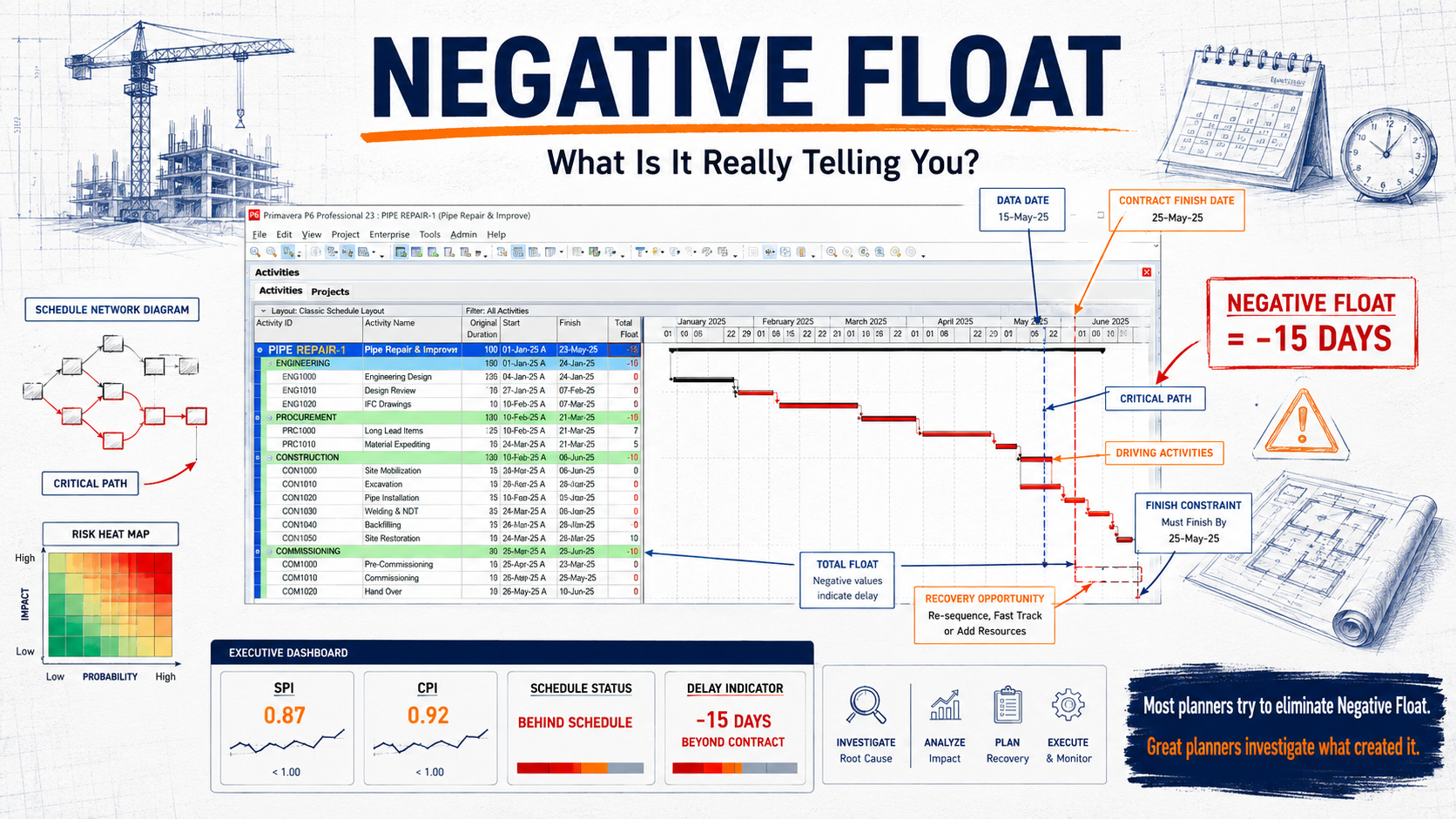
How We Fixed -19 Days of Negative Float in Primavera P6: A Construction Case Study
How three layers of trouble — out-of-sequence progress under Retained Logic, a forgotten Finish-On-or-Before milestone constraint, and genuine procurement slippage — combined to produce -19 days of total float on a hospital ward-block fit-out, and the re-sequencing recovery that restored positive float without crashing.
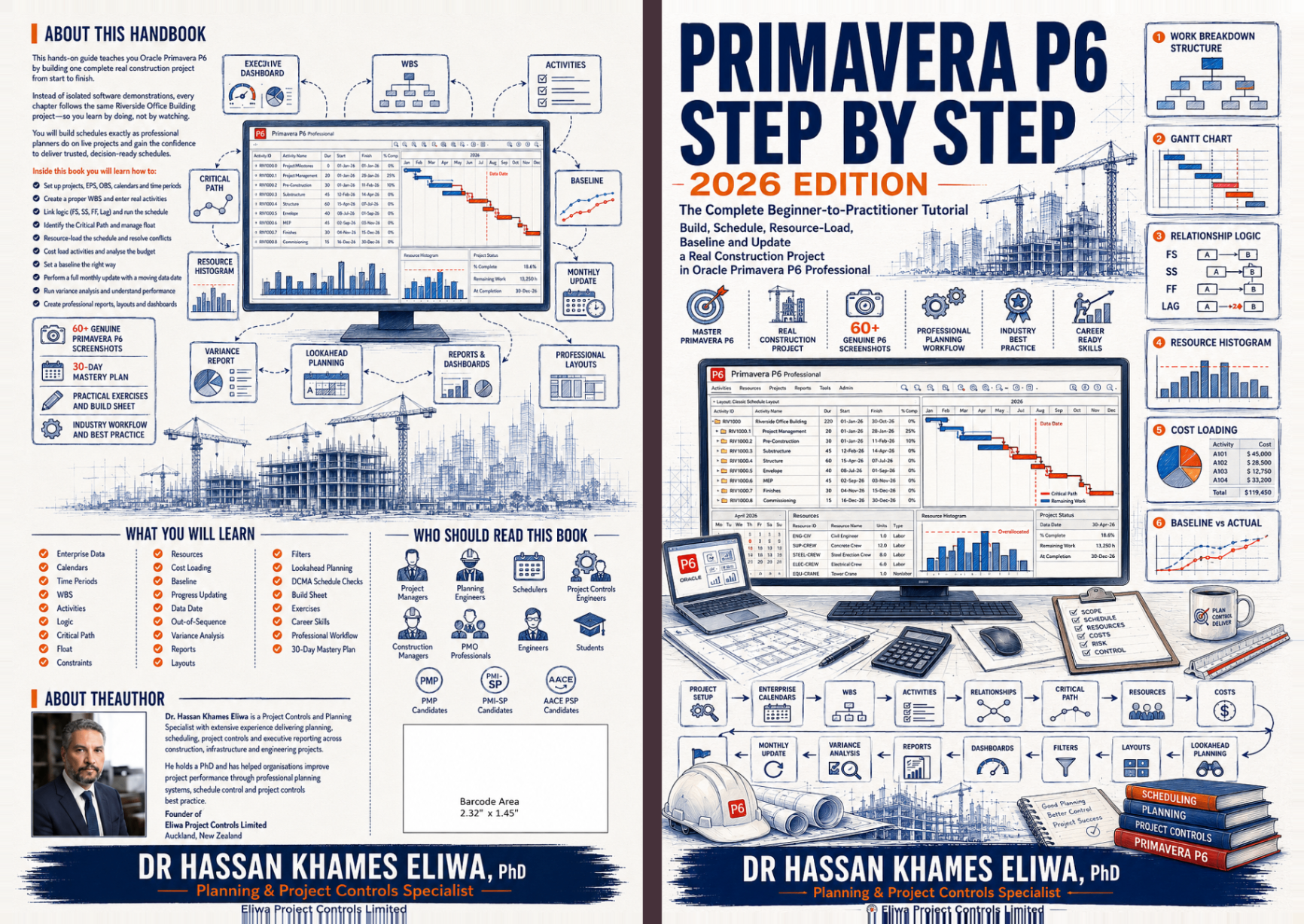
Inside the Riverside Office Building: How a Fictional Construction Project Teaches Real Primavera P6
A walk-through of the 2026 Edition of Primavera P6 Step by Step, built around a single continuous construction project so the consequences of early decisions surface exactly as they do on live jobs.
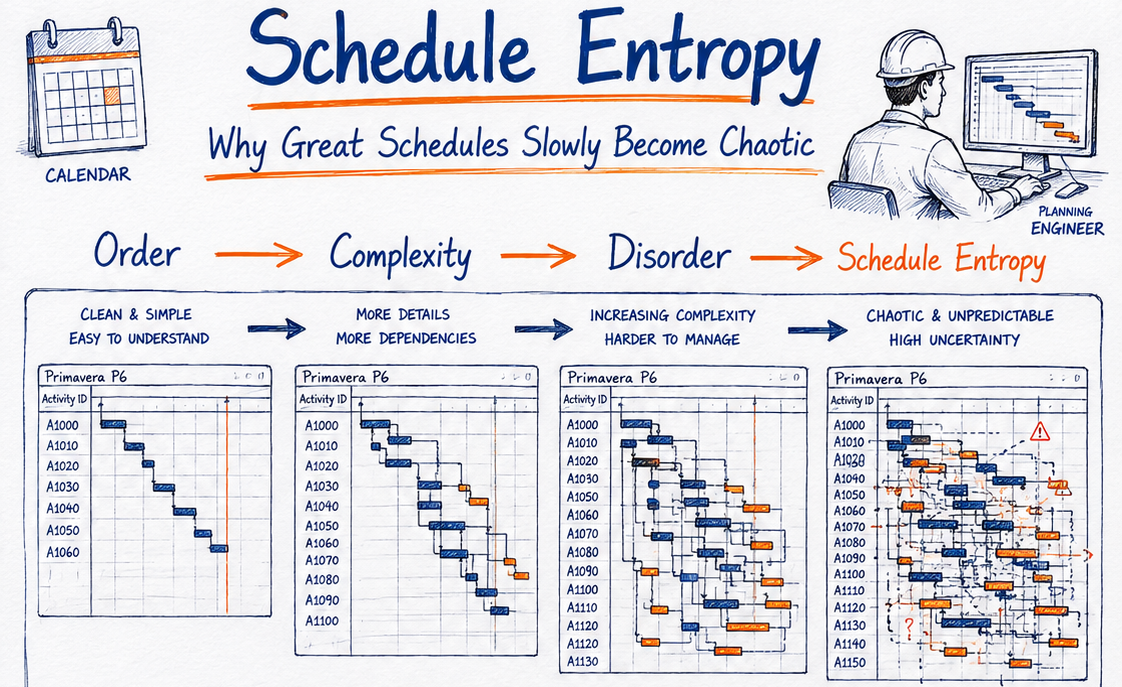
Schedule Entropy — Why Great Schedules Slowly Become Chaotic
A research-informed, practitioner's guide to schedule entropy — the early symptoms, the six root causes, a worked hospital fit-out example, an entropy health scorecard, and the disciplines that keep a Primavera P6 programme stable, legible and trusted.
From the A–Z Encyclopedia
Featured entries — definitions, principles and field-grounded applications.
Activity Definition
The process of identifying and documenting the specific actions required to produce project deliverables, decomposing work packages into discrete schedulable activities.
Agile Project Management
An iterative, adaptive approach to project delivery that emphasises customer collaboration, short feedback cycles, and continuous improvement.
Baseline Schedule
The approved, time-phased plan against which actual progress is measured and variance is reported throughout the project.
Budget Control
The disciplined monitoring of project spend against the approved budget through commitments, accruals, and variance reporting.
Critical Path Method (CPM)
A deterministic scheduling technique that identifies the longest chain of dependent activities and the activities that drive the project completion date.
Cost Control
The integrated discipline of estimating, baselining, monitoring, forecasting, and reporting project cost to drive corrective action and protect outcomes.
Delay Analysis
Forensic and prospective techniques used to identify, quantify, and apportion responsibility for schedule delay on construction and IT projects.
Digital Twin
A continuously updated digital representation of a physical asset or process used to monitor, simulate, and optimise performance across the lifecycle.
Built by a practising project controls engineer
PMMilestone.com is led by Dr. Hassan Eliwa, PhD — a senior planning and project controls engineer with 20+ years of international experience across construction, infrastructure, power generation and substations. He holds a PhD from Massey University (New Zealand), is the Founder of PMMilestone.org and PMMilestone.com, and is the author of practitioner-focused books on Project Controls, Primavera P6 scheduling and Earned Value Management — available through the PMMilestone.org books library and on Amazon.
Every entry is written or reviewed against field practice on capital projects, and cross-checked against PMI's PMBOK, PRINCE2, AACE recommended practices, ISO 21500, ANSI/EIA-748 for earned value, and DCMA scheduling guidance. We do not publish generic, machine-generated filler. Where our experience disagrees with the textbook — for example on the well-known weakness of classic SPI past 70% physical progress — we say so, and we recommend the field-grounded alternative.
Read the full editorial position on the About page, get in touch on the Contact page, and follow ongoing commentary on LinkedIn, X and Medium.
How PMMilestone.com relates to PMMilestone.org
Think of the two domains as the encyclopedia and the toolkit, sitting side by side. PMMilestone.org is the flagship operational platform — the Project Controls Academy, the free calculators, the books library, the PM glossary, learning tracks, certification resources, and the templates used by engineers worldwide. PMMilestone.com is the editorial and research wing — the A–Z encyclopedia, the long-form career guides, and the canonical reference library. Each encyclopedia entry on .com cross-links into the matching tool, template or course on .org, so a reader can move from the formula to the calculator to the worked example in a single click.
Who PMMilestone.com is built for
The platform serves project managers running construction, infrastructure or industrial programmes; planning and scheduling engineers looking for CPM, P6 and schedule-risk guidance; project controls engineers and PMOs integrating cost, schedule, risk and change; cost engineers building defensible EAC forecasts and EVM systems compliant with ANSI/EIA-748; construction managers and infrastructure leaders who need executive-grade reference material; owner-side advisors, lenders and assurance reviewers evaluating delivery risk; and graduates and career changers following the career guides into the project controls profession.
The editorial standard
We follow Google's Helpful Content guidelines and write for humans first. Every page that recommends a method, formula or threshold names the standard it is anchored to (PMBOK, PRINCE2, AACE, ISO 21500, ANSI/EIA-748, DCMA) and flags where the standards diverge. Corrections are welcomed — email hassan.eliwa@eliwa.co.nz. Where books and tools are referenced, an affiliation is disclosed in context; we do not accept undisclosed paid placement, and we do not republish AI-generated filler.
Why integration is the whole game
A scheduler who cannot read a cost report is half a professional. A cost engineer who cannot read a critical path is the other half. The encyclopedia is built around the belief that project controls is one integrated function — not three parallel disciplines — and that its value is the consistency between schedule, cost, risk and change. That is why entries on EVM, CPM, DCMA 14-point assessment and Variance Analysis cross-link rather than stand alone, and why every career guide treats integration as the central skill the practitioner must develop.
What's new
The site is updated on a rolling cadence. New encyclopedia entries appear weekly; existing entries are revised when industry guidance changes (for example, when AACE publishes a new recommended practice or DCMA updates scheduling guidance). The seven career guides above are the foundation of the career-paths library; further guides on AI-enabled project controls, owner-side maturity, and Lean / Last Planner System integration are in preparation.
Frequently Asked Questions
What is PMMilestone Research & Insights?
PMMilestone Research & Insights is the official knowledge hub of PMMilestone.org — a research-grade encyclopedia, article library and book series covering Project Management, Project Controls, Construction Management and Earned Value Management, written by practising planning and project controls engineers.Who writes the content on PMMilestone Research & Insights?
Editorial direction is led by Dr. Hassan Eliwa, PhD — Founder of PMMilestone.org, a senior planning and project controls engineer with 20+ years of international experience across construction, infrastructure, power generation and substations. Every encyclopedia entry, research article and book is reviewed against field practice on capital projects.How is the Encyclopedia of Project Management & Controls organised?
The encyclopedia is an A–Z reference of project management and project controls terms. Each entry includes a definition, principles, real-world applications, frequently asked questions and curated further reading on PMMilestone.org. You can browse by letter, by topic category, or search by keyword.Is the content on PMMilestone Research & Insights free to read?
Yes. All encyclopedia entries, research articles, case studies, career guides and industry reports are free to read. The Books Library links out to PMMilestone.org where full books and templates are available.How does this site relate to PMMilestone.org?
PMMilestone.org is the flagship platform — courses, calculators, templates and the project controls academy. PMMilestone.com (this site) is the editorial and research wing: the global encyclopedia, long-form research, and the authoritative reference library for project controls practitioners.Which project controls calculators are available on PMMilestone.org?
Companion calculators include the EVM Calculator (PV, EV, AC, CV, SV, CPI, SPI), the SPI Calculator (Schedule Performance Index and Earned Schedule SPI(t)), the CPI Calculator (Cost Performance Index and EAC forecasting), and the Schedule Health Checker that runs DCMA 14-point assessments on Primavera P6 and Microsoft Project XER/XML exports.What's the difference between Project Management and Project Controls?
Project management is responsible for delivering project objectives end-to-end — scope, schedule, cost, quality, risk, procurement, stakeholders and integration. Project controls is the independent measurement and forecasting function inside that — schedule, cost, EVM, change and risk reporting that tells the project manager (and the owner) whether the project is actually on track. On capital programs, controls reports to a controls director, not to the project manager whose performance it measures.